Is Your District Overtime-Ready for 2026?
New IRS reporting requirements in the Big Beautiful Bill Act mean districts need clean, defensible time data, starting now. Here’s everything you need to know and do to prepare.
What Changed, Why It Matters, and What to Do About It
A New Deduction, a New Burden
Due to the One Big Beautiful Bill Act, starting in 2025, eligible employees can deduct up to $12,500 in qualified overtime pay from their federal income taxes. But the IRS is shifting the documentation burden to employers.
By 2026, districts must separately report qualified overtime on W-2s using Box 12, code TT. That means tracking, isolating, and verifying FLSA-mandated overtime by employee and by pay period, with no room for estimation.
Layered Pay, Higher Stakes
K-12 compensation isn't simple. Shift differentials, stipends, split assignments, and union-negotiated premiums all complicate the question: which hours actually qualify?
Only the half-time premium on hours worked beyond 40 per week counts, and only for non-exempt staff under the FLSA. Districts that can't cleanly separate that data are exposed.
Start With the Data
Compliance starts at the point of time capture. If your time collection process can't produce clean, auditable records by employee, job code, and pay period, you're not ready.
Use the resources on this page, including our readiness checklist, self-assessment quiz, and blog series, to evaluate your current process and identify gaps before reporting requirements tighten.
What Districts are Saying
Districts across the country have already made the switch from manual time tracking to SmartClocks. Here's what that looks like in practice.
"We have paid out an incredible amount of overtime this year. With the SmartClock, It's a more accurate reflection of hours that people are actually working."

Doug Culler
"With web and mobile app clock-ins, people found loopholes and we couldn't track them even with IP Lockdown. There are no loopholes with the SmartClocks. We don't have to second guess the timesheets anymore."

Mike Roberts
"We used to have to print off every single timesheet for overtime and we would have to manually calculate it, manually enter it into the system. Whereas now with the SmartClocks it just automatically pulls everything over."2

Mandi Nicholas
Download Your K-12 Overtime Readiness Kit
Everything your team needs to evaluate your current time-tracking process and start closing gaps—before the IRS closes them for you.
What’s Inside:
- A step-by-step readiness checklist to evaluate and confirm your district's preparedness for the new requirements
- Practical steps to take
- Red flags to watch for
- An invitation to request a free Overtime Readiness Consultation
This Isn't Just a Payroll Problem
Overtime readiness touches every team that handles time data, employee records, or the systems that connect them.
Business Office & Payroll
You need an audit trail that ties every overtime hour to a verifiable punch, a job code, and a pay period—without manual reconstruction. When W-2 season hits, the data should already be there.
Human Resources
Classification clarity is everything. You need consistent policies for how overtime is approved, documented, and communicated—especially when employees start asking questions about their deductions.
Information Technology
Your time collection hardware has to stay up, integrate cleanly, and produce data your payroll system can trust. If IT isn’t at the table for this conversation, the whole chain is at risk.
Don’t Wait for W-2 Season to Find the Gaps
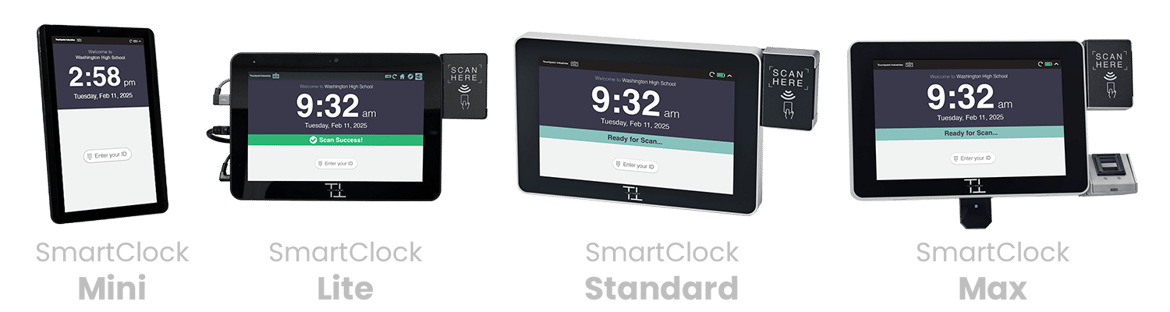
Overtime compliance starts at the point of time capture. Touchpoint SmartClocks log every punch with job codes, physical locations, and visual validation built in, giving your payroll team clean, auditable records without manual reconstruction. Your software partners handle the reporting. Touchpoint makes sure the data going in is worth reporting.